Uruguay vs Cape Verde Preview: Vozinha, Group H and World Cup 2026 Prediction
Uruguay vs Cape Verde prediction is one of the most interesting topics in Group H of the 2026 FIFA World […]
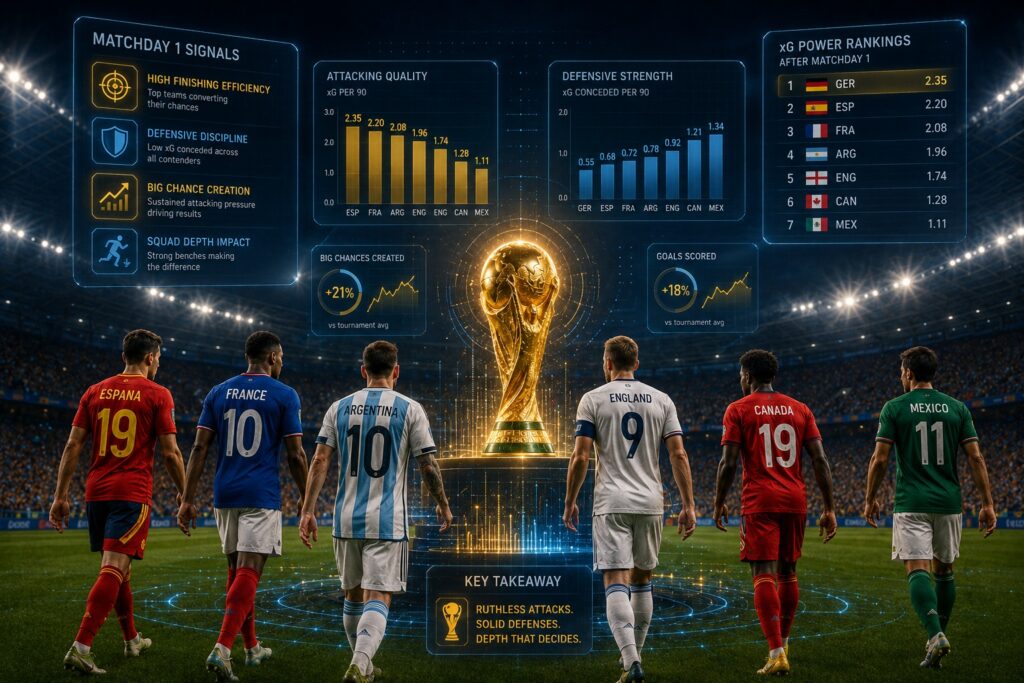
World Cup 2026 xG power rankings after Matchday 1 give us an early view of which teams are performing well beyond the basic group standings. At this stage...
 By GoalStatsLab
•
Jun 19, 2026
•
6 min read
By GoalStatsLab
•
Jun 19, 2026
•
6 min read

World Cup 2026 xG power rankings after Matchday 1 give us an early view of which teams are performing well beyond the basic group standings.
At this stage of the tournament, the table only shows points, wins, draws, losses and goal difference. Those numbers are important, but they do not always explain how a team actually played.
Expected goals, or xG, helps add more context. It measures the quality of chances created and conceded. A team can win without creating many clear chances, while another team can draw or lose despite producing better attacking situations.
That is why xG is useful in World Cup analysis. It helps separate the scoreline from the underlying performance.
Data note: These World Cup 2026 xG power rankings are based on matches completed after Matchday 1. Rankings may change as new group-stage matches are played and updated in the GoalStatsLab database.
Matchday 1 is always difficult to analyse.
Some teams start fast. Others play carefully. Some favourites struggle against defensive opponents, while outsiders can surprise with discipline, pressing or counter-attacks.
That is why World Cup 2026 xG power rankings should not be treated as a final verdict. They are an early signal.
The main goal is to identify which teams created strong chances, which teams limited danger, and which results may need deeper analysis.
For readers who are new to advanced football metrics, the GoalStatsLab football stats guide explains expected goals, shots, corners, cards and other football data indicators in a simple way.
Germany produced one of the strongest attacking signals of Matchday 1.
Their opening performance was not only important because of the scoreline. It also showed strong chance creation, attacking pressure and a positive expected goals profile.
In xG terms, this matters because a team that creates repeated high-quality chances is usually more reliable than a team depending on one isolated moment.
Germany’s attacking performance suggests they were not only efficient in front of goal. They also created the type of chances that can support future prediction models.
This makes Germany one of the most important teams to watch after Matchday 1.
Spain’s 0-0 draw with Cape Verde was one of the most surprising results of Matchday 1.
On paper, Spain were expected to control the match and create enough chances to win. But Cape Verde defended with discipline, stayed compact and made the game uncomfortable.
This is exactly why xG analysis is useful. A draw does not always mean both teams performed equally. It can show whether one team created enough chances but failed to finish, or whether the opponent truly limited clear opportunities.
Spain remain one of the strongest technical teams in the tournament, but their opening result showed that control of possession is not always enough.
For more context, read our analysis of the Spain 0-0 Cape Verde historic World Cup draw.
France and Argentina also remain important teams in the early World Cup 2026 xG power rankings.
France opened with a strong result against Senegal, showing attacking quality and individual threat. Their profile is important because France can create danger in different ways: through transitions, wide attacks, individual actions and central combinations.
Argentina also started with a convincing result against Algeria. Tournament experience, attacking control and finishing quality make Argentina a team that prediction models must continue to respect.
After Matchday 1, both teams remain among the strongest contenders, even if the xG rankings are still early and likely to change.
England and Canada were two of the most eye-catching teams from an attacking perspective.
England’s 4-2 win over Croatia created a strong early signal. Scoring four goals against a respected opponent immediately puts England into the conversation. However, conceding twice also means their defensive numbers should be watched closely in the next matches.
Canada’s 6-0 win over Qatar was another major result. A victory by that margin affects goal difference, confidence and early team rankings.
But one big win is not enough to confirm long-term strength. The next matches will show whether England and Canada can maintain attacking quality against different opponents.
Power rankings should not only focus on goals scored.
In World Cup football, defensive strength is just as important as attacking quality. A team that limits high-quality chances can go far, even if it does not dominate every match.
This is where expected goals against becomes useful.
Expected goals against shows how much danger a team allows. A low xG-against profile can indicate strong defensive structure, good pressing, compact spacing and smart game management.
Mexico are an example of a team worth tracking defensively after the opening matches. Their early results suggest strong control and limited danger conceded.
Defensive numbers are especially important in a tournament where one goal can decide qualification.

After Matchday 1, the World Cup 2026 xG power rankings suggest several early trends.
Germany have one of the strongest attacking profiles. Spain still have a strong technical profile despite the draw with Cape Verde. France and Argentina remain major contenders. England and Canada sent strong attacking signals. Mexico are showing defensive strength.
These are not final conclusions.
They are early data points.
The group stage is still developing, and every new match can change the rankings. That is why it is important to update xG rankings after each matchday instead of treating the first round as a final answer.
The expanded FIFA World Cup 2026 includes 48 teams and 104 matches, with fixtures and results available through the official FIFA World Cup 2026 scores and fixtures page.
Matchday 2 will be important because it tests whether the early signals are real.
Germany need to show that their attacking numbers can continue against a stronger opponent. Spain need to turn control into goals. France and Argentina will try to build momentum. England and Canada need to prove that their attacking starts were not one-match spikes.
For prediction readers, the key question is not only who wins.
The key question is how teams perform.
A narrow win with low chance creation is different from a dominant win with repeated high-quality chances. A draw with strong xG can be more promising than a lucky victory with weak attacking numbers.
That is why GoalStatsLab tracks fixtures, group standings, team leaders, player trends and prediction signals in the World Cup 2026 stats hub.
The World Cup 2026 xG power rankings after Matchday 1 give us an early picture of team performance.
Germany lead the early attacking data. Spain remain dangerous despite their draw. France and Argentina continue to look like serious contenders. England and Canada have made strong attacking statements, while Mexico’s defensive profile deserves attention.
The standings show who has points.
The xG data helps explain who is really performing.
Follow updated World Cup 2026 predictions and match analysis on GoalStatsLab as the tournament continues.

Uruguay vs Cape Verde prediction is one of the most interesting topics in Group H of the 2026 FIFA World […]

Cape Verde did not need a goal to make history (Spain 0-0 Cape Verde). In their first ever FIFA World […]

World Cup 2026 stats are already showing some interesting early patterns in the group stage. The tournament has started with […]