

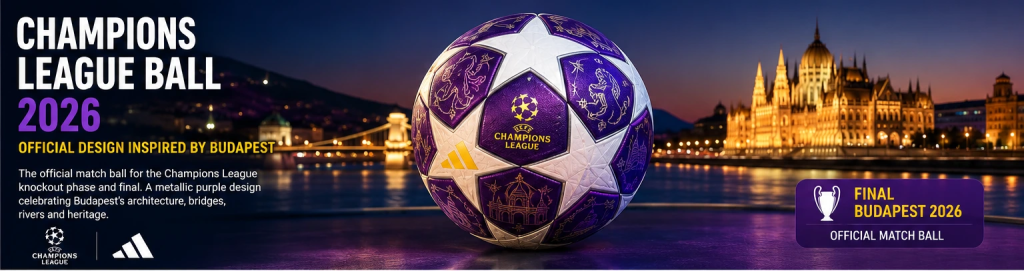
The official Champions League ball for the 2026 final was the adidas UEFA Champions League Final Budapest 2026 Official Match Ball.
The ball features a dark metallic-purple design, white star panels and yellow branding. Its graphics were inspired by Budapest’s architecture, rivers, bridges, nightlife and Art Nouveau heritage.
The Budapest ball made its competitive debut during the 2025/26 Champions League knockout phase. It was one of three notable match-ball designs used during the season, alongside the standard league-stage ball and a special 25th-anniversary Starball. (UEFA)
What is the official Champions League ball for 2026?
The official 2026 final ball is called the UEFA Champions League Final Budapest 2026 Official Match Ball.
| Detail | Information |
|---|---|
| Manufacturer | adidas |
| Competition | UEFA Champions League |
| Season | 2025/26 |
| Main use | Knockout phase and final |
| Main colours | Dark purple, white and yellow |
| Design inspiration | Budapest |
| Official Pro price in the US | $170 when checked in July 2026 |
| Construction | Thermally bonded and seamless |
| Certification | FIFA Quality Pro |
The official Pro version received FIFA Quality Pro certification, which tests characteristics such as weight, shape retention, water absorption and size consistency. Adidas listed the ball at $170 in the United States when checked in July 2026. (adidas)
Champions League 2026 final ball design explained
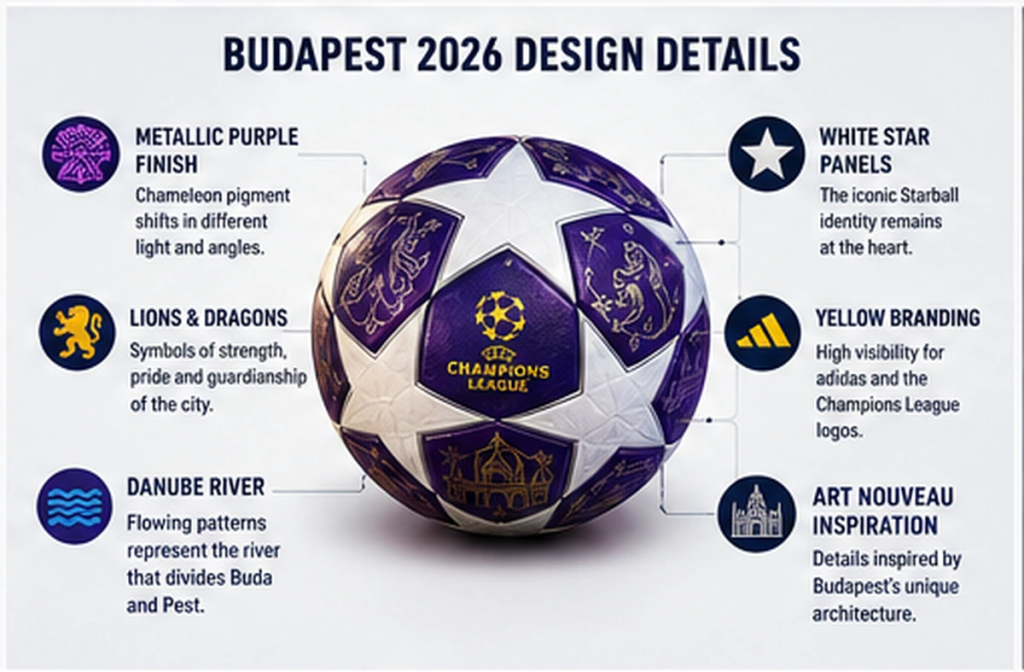
The design is based on Budapest’s identity as two historically distinct areas—Buda and Pest—joined across the River Danube.
Metallic-purple base
A rich purple metallic surface forms the main background. UEFA says the finish uses a chameleon pigment that changes subtly depending on light, angle and movement.
Under stadium lights, the colour can appear brighter, darker or more reflective as the ball rotates.
White Starball panels
The recognisable white stars remain the central visual feature.
Although the surrounding graphics change each season, the star-shaped panel identity allows supporters to recognise a Champions League ball immediately.
Yellow adidas and Champions League branding
The adidas and competition marks are presented in yellow to create strong contrast against the purple-and-white surface.
Budapest architecture and nightlife
The graphic system draws from:
- Budapest’s Art Nouveau architecture;
- the River Danube;
- the city’s bridges;
- illuminated streets;
- classical buildings;
- modern nightlife.
Lions and dragons
Lion and dragon motifs are incorporated into the graphics as symbols associated with strength, pride and guardianship.
UEFA describes the ball as a visual story of the host city rather than only a colour variation of the standard seasonal design.
How many Champions League balls were used in 2025/26?
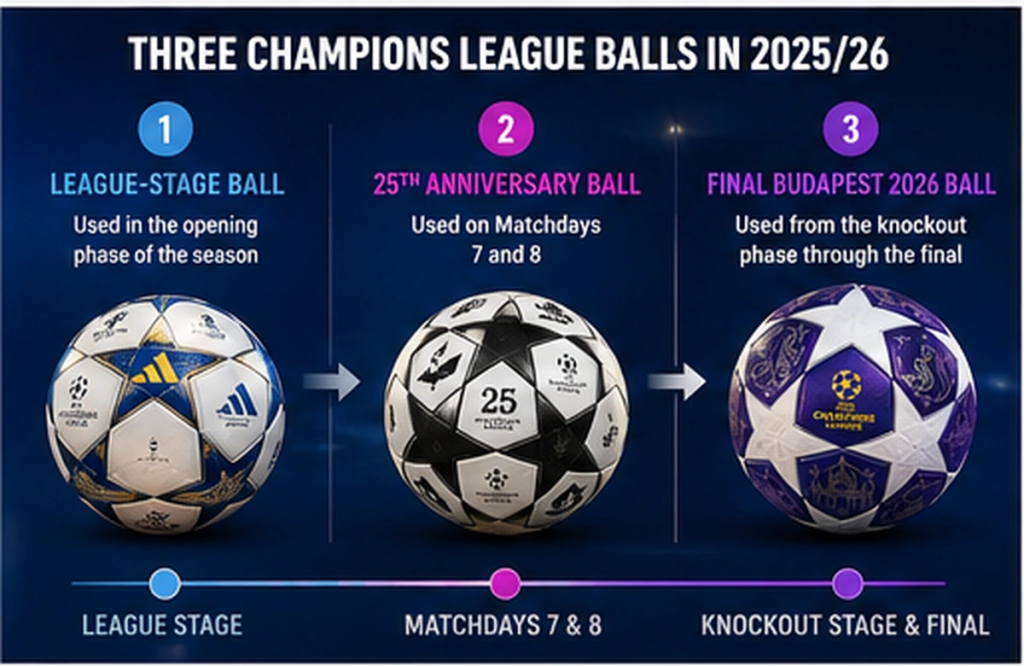
The 2025/26 Champions League season featured three notable official ball designs.
1. UCL 2025/26 league-stage ball
The standard league-stage ball opened the season.
It used a white base with dark blue, gold and additional graphic detailing. The official Pro version was priced at $170 in the United States. (adidas)
2. Champions League 25th-anniversary ball
Adidas then released a special ball celebrating 25 years of its Champions League partnership.
The design recreated the colours and graphic print of the original Finale 1 Starball, while adding a modern black-to-purple colour-shifting effect.
It was used on Champions League Matchdays 7 and 8. (UEFA)
3. Final Budapest 2026 ball
The purple Budapest ball took over for the knockout phase and remained the defining ball through to the final.
| Ball | Period used | Main visual identity |
|---|---|---|
| League-stage ball | Opening phase of 2025/26 | White, dark blue and gold |
| 25th-anniversary ball | Matchdays 7 and 8 | Tribute to the original Finale 1 |
| Budapest 2026 ball | Knockout phase and final | Purple Budapest-inspired graphics |
Why does the Champions League ball have stars?
The stars are based on the Champions League’s visual identity.
Adidas introduced the first modern star-panelled Champions League ball in 2001. Since then, the Starball has become one of the most recognisable match-ball designs in football.
The stars do not represent:
- the number of Champions League titles won by a club;
- the number of teams in the competition;
- the number of countries involved;
- the number of European trophies.
They are a competition-wide visual signature connected to the Champions League logo.
The graphics, colours and host-city themes change, but the stars maintain continuity between different editions.
When was the first Champions League Starball introduced?
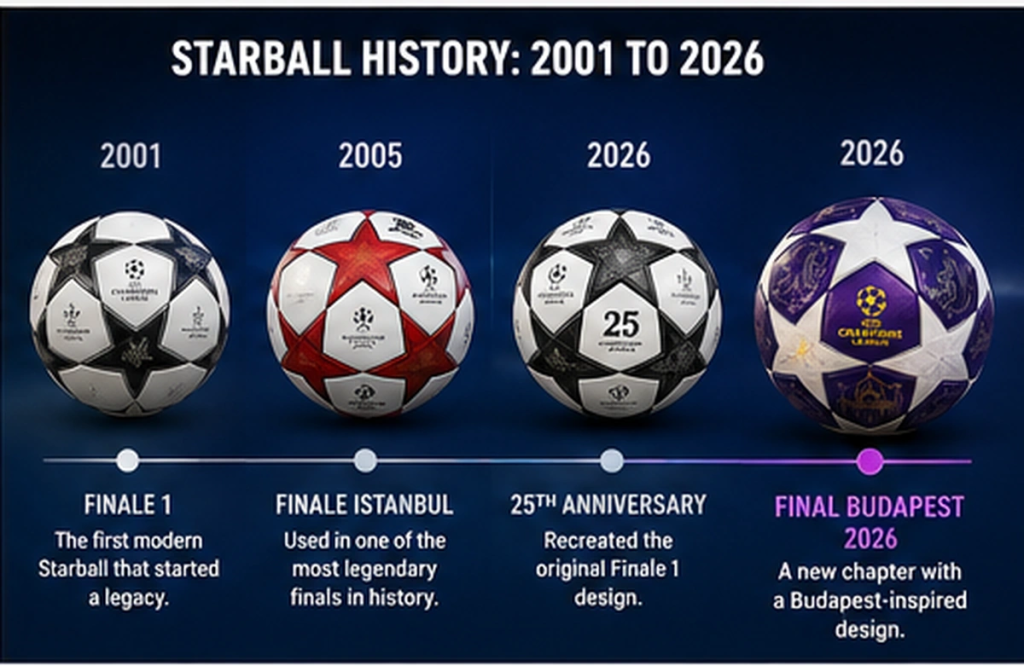
The first adidas Starball was the Finale 1, introduced in 2001.
Its white, black and silver appearance established the visual template used by later Champions League balls.
In January 2026, adidas recreated that original graphic for the partnership’s 25th anniversary. The updated version retained the classic print while introducing modern materials and a colour-shifting finish.
Champions League ball history: key editions
Rather than every seasonal colour variation, these are some of the most important Starballs in the competition’s modern history.
| Season | Ball | Why it matters |
|---|---|---|
| 2000/01 | Finale 1 | Introduced the modern star-panel identity |
| 2004/05 | Finale Istanbul | Used during Liverpool’s famous comeback against AC Milan |
| 2009/10 | Finale Madrid | Celebrated ten years of Finale designs |
| 2010/11 | Finale London | Used for the Wembley final |
| 2017/18 | Finale Kyiv | Featured a blue-and-yellow host-city theme |
| 2020/21 | Finale Istanbul 21 | Celebrated 20 years of the Starball |
| 2021/22 | Finale Paris | Associated with a final relocated from Saint Petersburg to Paris |
| 2022/23 | Finale Istanbul | Used when the final finally returned to Istanbul |
| 2024/25 | Finale Munich | Used for the Munich final |
| 2025/26 | 25th Anniversary Ball | Reimagined the original Finale 1 |
| 2025/26 | Final Budapest 2026 | Purple Art Nouveau-inspired final ball |
Most iconic Champions League ball designs
Finale 1 — 2001
The original modern Starball established a design identity that has lasted for 25 years.
Finale Istanbul — 2005
The ball became closely associated with one of the competition’s most famous finals, when Liverpool recovered from 3–0 down against AC Milan.
Finale Madrid — 2010
This anniversary edition referenced earlier final-ball designs and became a popular collector’s item.
Finale Istanbul 21
Released to commemorate 20 years of the Starball, this edition revisited elements from earlier designs.
25th-anniversary ball — 2026
This ball directly recreated the original Finale 1 graphics for a new generation.
Final Budapest 2026
The Budapest edition stands out because of its metallic purple surface, host-city artwork and colour-shifting finish.
Technology inside the official Champions League ball
The official Pro ball uses thermally bonded, seamless construction.
Instead of traditional stitched seams, its panels are fused together to create a consistent surface.
According to UEFA, this construction is designed to deliver:
- accuracy;
- consistent movement;
- touch control;
- flight stability;
- performance under elite match conditions.
The ball’s textured exterior is intended to help players control passes, crosses and shots, while its internal construction is designed to retain shape and air pressure.
The Pro model carries FIFA Quality Pro certification, the highest FIFA testing level listed by adidas for the product.
Official Champions League ball vs replica versions
Adidas sells several ball tiers carrying Champions League designs.
The exact construction can vary between releases, but the versions are generally aimed at different types of player.
| Version | Best for | General performance level | Typical price level |
|---|---|---|---|
| Pro | Professional and elite matches | Highest | Highest |
| Competition | Competitive 11-a-side football | Very high | High |
| League | Amateur matches and advanced training | Mid-range | Medium |
| Training | Regular practice | Durable | Lower |
| Club | Recreational use | Basic | Entry level |
| Mini | Collection, display and skills | Not a full-size match ball | Lowest |

Adidas describes Competition balls as suitable for 11-a-side matches, League balls for casual games and Training balls for practice. (adidas)
Which Champions League ball should you buy?
Choose the Pro ball when:
- you want the closest product to the ball used by professional players;
- performance is more important than price;
- it will mainly be used on quality natural-grass pitches;
- you are buying a premium collector’s item.
Choose the League ball when:
- you need a full-size ball for amateur matches;
- you want a balance between price and performance;
- the ball will be used regularly;
- you do not need professional-match certification.
Choose the Training or Club ball when:
- durability matters more than elite performance;
- the ball will be used frequently;
- you play on artificial turf or harder surfaces;
- you need a lower-cost option.
How much does the Champions League ball cost?
The price depends on the model and region.
The following prices were checked on official adidas and UEFA store pages on July 14, 2026.
| Version | Verified price | Store |
|---|---|---|
| Final Budapest Pro Ball | $170 | adidas US |
| Final Budapest League Ball | $45 | adidas US |
| Final Budapest Training Foil Ball | $38 regular price; $33 sale price when checked | adidas US |
| Final Budapest League Ball | €41.95 | UEFA Store Europe |
| Final Budapest Mini Ball | €15.95 | UEFA Store Europe |
The UEFA Store listed the League Ball at €41.95 and the Mini Ball at €15.95. Adidas listed the Pro Ball at $170 and the League version at $45 in the United States. Prices and stock may change by country, retailer and promotion. (adidas Pro, adidas League, UEFA Store)
Why is the official Pro ball expensive?
The Pro version costs more because it uses the same general performance specification required for elite competition.
Its price reflects:
- FIFA Quality Pro certification;
- thermally bonded construction;
- premium materials;
- performance testing;
- official competition licensing;
- limited seasonal designs.
For normal training, the League or Training model is likely to provide better value.
Where can you buy the official Champions League ball?
The official ball is normally sold through:
- adidas football ball stores;
- the official UEFA competition store;
- selected authorised football retailers;
- major sporting-goods stores.
Avoid listings that use phrases such as “Champions League style” without stating the official product tier or manufacturer.
Before buying, check:
- The adidas product code;
- The exact tier—Pro, Competition, League, Training or Club;
- Whether it is size 5;
- Whether the seller is authorised;
- Whether the product is new or a previous-season edition;
- Return and authenticity policies.
Can you use a Champions League ball on artificial grass?
Yes, but the most expensive Pro ball is not necessarily the best option for regular artificial-turf use.
Artificial surfaces can be more abrasive than quality natural grass. Frequent use may accelerate wear on a premium match ball.
For weekly training on artificial grass, consider:
- a League ball;
- a Training ball;
- a model designed for repeated use;
- a ball with a more durable outer surface.
Reserve the Pro version for matches, collection or high-quality playing surfaces.
Is the Champions League ball size 5?
The main adult match balls are size 5.
Size 5 is the standard full-size football used in senior competitive matches.
Mini versions are much smaller and are intended primarily for:
- display;
- collections;
- gifts;
- close-control skill exercises;
- children’s casual play.
Always check the product title before buying because an image alone may not make the size obvious.
Champions League ball FAQs
What ball was used in the 2026 Champions League final?
The UEFA Champions League Final Budapest 2026 Official Match Ball was used during the knockout phase and final. It was designed by adidas and inspired by Budapest.
What colour is the Champions League ball for 2026?
The official final ball has a metallic dark-purple base, white star panels and yellow branding.
Why does the Champions League ball have stars?
The stars reflect the Champions League’s Starball logo and visual identity. They do not represent a club’s number of titles.
Who makes the Champions League ball?
Adidas manufactures the official Champions League match balls. The 2025/26 season marked 25 years of the adidas–Champions League ball partnership.
How much is the official Champions League ball?
The 2026 Final Pro Ball was listed at $170 in the United States when checked in July 2026. Prices can change.
What is the difference between the official and replica ball?
The official Pro version uses elite-level construction and carries FIFA Quality Pro certification. Lower tiers are designed for competitive amateur matches, training or recreational use.
Is a Champions League ball different every season?
Yes. Adidas releases new seasonal graphics, with final balls often inspired by the host city. The Starball identity remains consistent.
How many Champions League balls were used in 2025/26?
Three notable designs were used: the standard league-stage ball, the 25th-anniversary ball and the Budapest 2026 final ball.
Can I use the official ball on artificial turf?
It can be used, but a cheaper League or Training model may be more suitable for frequent artificial-turf use.