Bundesliga Corners 2025/26: Teams With the Most Corners
Bundesliga Corners rankings for 2025: Bayern München lead with 6.35 using GoalStatsLab data.
Introduction Home advantage in football has always been one of the most discussed factors in match analysis. For decades, teams have been expected to perform better at home...
 By GoalStatsLab
•
Jun 13, 2026
•
9 min read
By GoalStatsLab
•
Jun 13, 2026
•
9 min read

Home advantage in football has always been one of the most discussed factors in match analysis.
For decades, teams have been expected to perform better at home than away. The reasons seem obvious: familiar stadium, supportive crowd, less travel, normal routine, and more confidence.
But modern football has changed.
Teams travel better, stadium conditions are more standardized, tactical preparation is more advanced, and data analysis has become part of the game. This raises an important question:
Is home advantage in football still a real edge?
The answer is yes, but it depends on the team, league, stadium, travel distance, tactical style, and match context.
In this article, we will explain how home advantage works, why it matters, when it can be overrated, and how to use it in smarter football match predictions.
Home advantage in football refers to the extra benefit a team may have when playing in its own stadium.
This advantage can appear in different ways:
In simple terms, home advantage means that a team may perform better at home than it does away.
However, not every team benefits equally.
Some teams are very strong at home but weak away. Others play with similar performance levels in both conditions. Some counterattacking teams may even perform better away because they get more space.
That is why home advantage in football should not be assumed blindly. It should be measured.
Football is not played only with numbers. Environment matters.
A home match can change the emotional and tactical energy of a team. Players may feel more confident, fans can create pressure, and the visiting team may need to adapt to unfamiliar conditions.
Home advantage in football can be especially important in:
But it is not always decisive.
A strong away team with better tactical structure can still dominate. A weak home team does not become strong just because it plays at home. The key is to analyze how each team actually performs in home and away situations.
Home advantage in football is not caused by one thing. It is the result of several factors working together.
Here are 8 key factors that still matter.
The crowd is one of the most visible parts of home advantage.
A strong home crowd can give players emotional energy. It can also create pressure on the away team, especially during dangerous attacks, referee decisions, or late-game moments.
Crowd support may influence:
Some stadiums are known for creating difficult environments for away teams. Smaller stadiums can also be intense because the fans are closer to the pitch.
However, crowd support alone does not guarantee performance. A team still needs tactical quality and execution.
Home teams know their stadium better.
This includes:
These small details may not look important, but at professional level, small advantages can matter.
A team that plays every week on the same pitch may be more comfortable with passing rhythm, pressing triggers, and defensive positioning.
This is one reason why home advantage in football can still be relevant even when teams are similar in quality.
The home team usually avoids long travel.
The away team may need to deal with:
Travel can affect performance, especially when teams play several matches in a short period.
This matters in domestic leagues, continental competitions, and international football.
A team that plays away after a midweek European match may be physically weaker than usual. In this case, home advantage can become more important.
Many teams play more aggressively at home.
They may press higher, attack with more players, take more risks, and control possession more often.
At home, teams often feel pressure to dominate the game. This can increase:
But there is also a risk.
If a home team attacks too much, it can leave space behind for counterattacks. This is why some away teams perform well against aggressive home sides.
Home advantage in football should therefore be analyzed together with tactical style.
Referees are expected to be neutral. However, football matches are emotional environments, and crowd pressure can sometimes influence the rhythm of decisions.
This does not mean referees intentionally favor home teams. But home crowds can create pressure during:
Even small decisions can affect match flow.
A home team that receives more attacking free kicks, more corners, or fewer cards may gain small advantages during the match.
This is one reason why home advantage has historically been discussed in football analysis.
Players are human.
Playing at home can create a stronger sense of comfort and control.
Home players usually sleep at home or follow a familiar routine. They know the stadium, the fans, the environment, and the expectations.
This can influence:
Away players may face hostile crowds, pressure, unfamiliar routines, and travel fatigue.
Psychological comfort is difficult to measure, but it can influence performance.
Not all teams play the same way at home and away.
Some teams become more attacking at home and more defensive away. Others keep the same tactical identity regardless of location.
This is why analyzing home advantage in football requires separate home and away data.
Example:
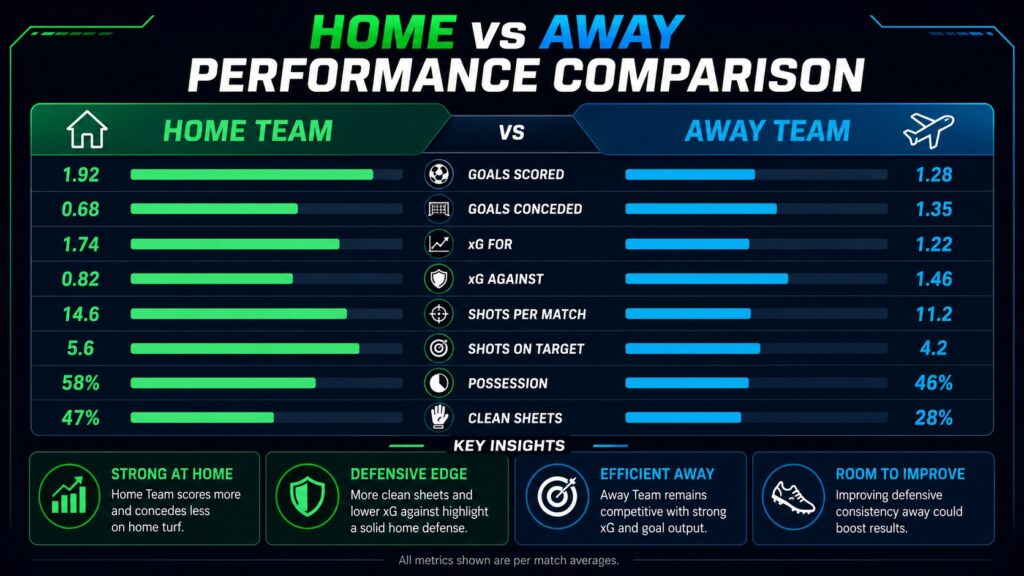
| Metric | Team at Home | Team Away |
|---|---|---|
| Goals scored per match | 2.10 | 1.05 |
| xG For | 1.85 | 1.10 |
| Shots per match | 15.2 | 9.4 |
| Possession | 58% | 46% |
This team clearly changes performance depending on location.
Another team may show almost equal numbers home and away. That team may be less dependent on home advantage.
Home advantage is not equal in every league.
Some leagues have intense stadium atmospheres, long travel distances, difficult weather conditions, or strong tactical differences between home and away teams.
In some countries, travel distance can be a major issue. In others, stadium atmosphere may be the main factor.
A proper match prediction should consider league context.
For example:
Home advantage in football becomes more useful when analyzed within the correct league environment.
To use home advantage correctly, you need to compare separate home and away statistics.
Do not rely only on the league table.
Important indicators include:
For a broader pre-match checklist, read our guide on Football Match Analysis: 9 Powerful Stats Before Betting .
Example:
| Indicator | Home Team at Home | Away Team Away |
|---|---|---|
| Goals scored | 2.00 | 1.10 |
| Goals conceded | 0.90 | 1.70 |
| xG For | 1.80 | 1.20 |
| xG Against | 0.95 | 1.75 |
| Shots | 14.5 | 9.2 |
| Clean sheets | 45% | 18% |
Expected Goals can also make home and away analysis more accurate because it shows whether a team is creating real scoring chances or simply scoring from low-quality shots. If you want to understand this metric in detail, read our full guide: Expected Goals in Football: 7 Powerful xG Prediction Tips .
This type of comparison is more useful than simply saying “the home team has home advantage.”
A strong home team against a weak away team is different from a weak home team against a strong away team.
Home advantage in football is useful, but it can also be overrated.
Here are situations where you should be careful.
A poor team does not automatically become strong at home.
If the team has weak attacking numbers, high xG Against, and poor defensive structure, home advantage may not be enough.
Some teams are excellent away from home.
They may defend well, counterattack effectively, and stay calm under pressure.
Against these teams, home advantage may be smaller.
Not every home crowd creates strong pressure.
A low-intensity stadium atmosphere may reduce the emotional edge.
Cup finals, international tournaments, and special fixtures may be played at neutral venues.
In these cases, traditional home advantage may not apply.
A home team may dominate most opponents but struggle against teams that defend deep and counterattack.
Tactical matchup can be more important than location.
If the home team played recently and is tired, the home advantage can be reduced.
Rest days matter.
Home advantage in football can influence different betting markets.
A strong home team may deserve shorter odds, especially if the away team struggles on the road.
But always compare odds with real probability.
Some home teams attack more aggressively, increasing goal potential.
However, if the away team defends deep, the game may become slower.
If the home team attacks but concedes counterattacks, BTTS can become interesting.
Home teams that attack wide and dominate possession may generate more corners.
Intense home crowds and pressure can increase match aggression, especially in derbies or important games.
GoalStatsLab can turn home advantage into useful football insights.
On match pages, the platform can show:
This can help users understand whether the home team really has an edge or whether the advantage is being exaggerated.
For example, a match page could display:
| Factor | Home Team | Away Team |
|---|---|---|
| Home/Away Form | Strong | Weak |
| xG Difference | +0.85 | -0.45 |
| Defensive Stability | High | Low |
| Goal Trend | Over tendency | Concedes often |
| Home Advantage Signal | Strong | Risky away profile |
This makes the prediction more transparent.
Many football fans make mistakes when using home advantage.
Not every home team is strong.
You need data.
A strong away team can cancel much of the home advantage.
Wins are important, but performance metrics such as xG, shots, goals, and clean sheets can tell a deeper story.
A team may have strong home numbers because it played weak opponents.
Always check the quality of opposition.
A home team that only needs a draw may play more carefully. A team fighting relegation may be more aggressive.
Context changes everything.
To understand home advantage in football and football analytics better, you can explore these trusted resources:
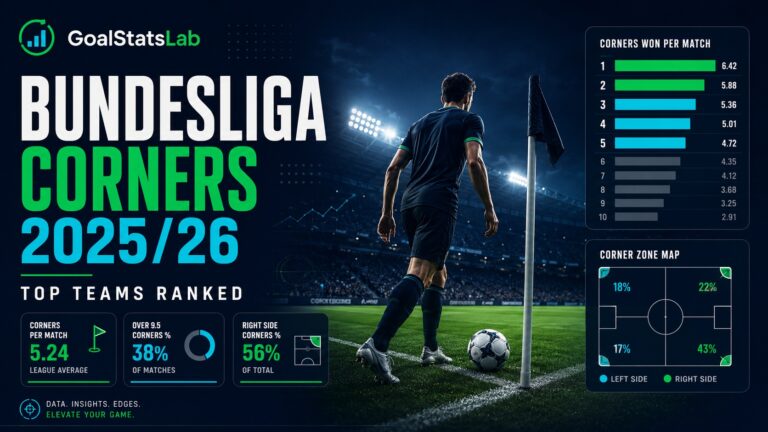
Bundesliga Corners rankings for 2025: Bayern München lead with 6.35 using GoalStatsLab data.

Premier League shots on target data gives us a clearer view of which players are not only shooting often, but […]

Premier League most shots data for the 2025/26 season gives us a clear view of which players are carrying the […]