Top 5 Football Players of the 2025/26 Season: Who Leads the GSPI Ranking?
The 2025/26 season produced outstanding individual performances across Europe and North America. Some players dominated through goals, others through creativity, […]


Saibari vs Musiala Bayern Munich have added another major attacking option to Vincent Kompany’s squad. Ismael Saibari has joined the German champions from PSV Eindhoven on a contract...
By GoalStatsLab
•
Published Jul 20, 2026
•
7 min read
Bayern Munich have added another major attacking option to Vincent Kompany’s squad.
Ismael Saibari has joined the German champions from PSV Eindhoven on a contract running until June 2031. Bayern did not officially disclose the transfer fee, although reports place the deal at around €50 million, potentially rising through performance-related bonuses.
The signing immediately creates an intriguing tactical question.
Will Saibari compete directly with Jamal Musiala for Bayern’s central attacking role, provide cover across several forward positions, or allow Kompany to build a more fluid system in which both players can start?
The answer is unlikely to be as simple as choosing one over the other.
Saibari arrived at the 2026 World Cup as an important part of Morocco’s attack, but his performances quickly elevated him into one of the tournament’s breakout players.
He scored against Brazil, Scotland and Haiti during the group stage. His strike after 69 seconds against Scotland was the quickest goal of the tournament at that point, although that mark was broken later the same day. Saibari also converted the decisive penalty when Morocco eliminated the Netherlands following a 1–1 draw in the Round of 32.
Those performances strengthened the reputation he had already developed at PSV.
Across 142 senior appearances for the Dutch club, Saibari recorded 42 goals and 29 assists. Bayern highlighted his experience, goal threat, intensity and ability to operate in several attacking roles when announcing the transfer.
Max Eberl described him as one of the World Cup’s most exciting attacking players and said he would add quality and unpredictability to Bayern’s attack.
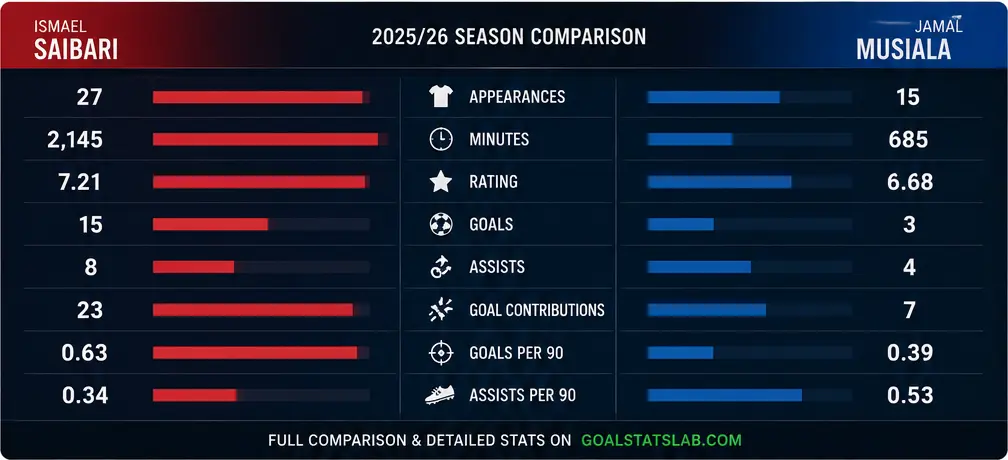
The GoalStatsLab comparison uses their 2025/26 club data.
| Metric | Ismael Saibari | Jamal Musiala |
|---|---|---|
| Appearances | 27 | 15 |
| Minutes | 2,145 | 685 |
| Average rating | 7.21 | 6.68 |
| Goals | 15 | 3 |
| Assists | 8 | 4 |
| Goal contributions | 23 | 7 |
| Goals per 90 | 0.63 | 0.39 |
| Assists per 90 | 0.34 | 0.53 |
Compare Saibari and Musiala across goals, assists, ratings and per-90 performance on GoalStatsLab.
At first glance, Saibari leads most of the major totals.
He made 12 more appearances, played 1,460 additional minutes, scored 12 more goals and produced 16 more total goal contributions.
His higher rating and superior goals-per-90 rate also support the argument that he was the more productive scorer during the selected period.
However, Musiala holds one important advantage:
0.53 assists per 90 compared with Saibari’s 0.34.
That figure suggests Musiala remained the more productive creator relative to his time on the pitch.
This is not a perfectly equal comparison.
Saibari played more than three times as many minutes as Musiala. Raw totals therefore favour the player who was available more often and had a much larger sample.
The two players also produced their numbers in different teams and competitions, under different tactical conditions.
The fairest interpretation is:
For that reason, the comparison should not be presented simply as “23 goal contributions against seven.”
The per-90 data and tactical context are essential.
There is significant overlap, but they are not identical players.
Musiala is most dangerous when receiving between midfield and defence, turning under pressure and carrying the ball towards the penalty area. Bayern have increasingly built their central attacking structure around his ability to progress through tight spaces.
He also inherited Bayern’s number 10 shirt, reflecting his long-term importance to the club’s attacking project.
Saibari can also operate as a central attacking midfielder, but his role at PSV frequently involved more direct runs into the box, movement beyond the striker and physical attacks on space.
Bayern officially presented him as a versatile forward rather than only as a conventional midfielder. The club specifically highlighted his unpredictability, intensity and goal threat.
This means he could be used as:
There will be competition, but it may not always be for one fixed position.
Musiala’s recent availability is one of the main reasons Bayern required additional attacking depth.
He suffered a broken leg and ankle injury during the 2025 Club World Cup and returned after 196 days, recording an assist in his comeback against RB Leipzig in January 2026.
After representing Germany at the 2026 World Cup, he underwent a planned minor routine procedure connected to the medical protocol following that earlier injury.
Bayern stated that the operation had been scheduled in advance and that Musiala was expected to follow a structured pre-season programme before returning for the club’s first competitive fixtures.
This context helps explain his limited 685-minute sample in the GoalStatsLab comparison.
His lower totals were not necessarily evidence of declining ability. They were heavily influenced by availability.
Saibari gives Bayern protection against another interruption, while also creating genuine competition when both players are fit.
This is the most conservative and probably the most immediate option.
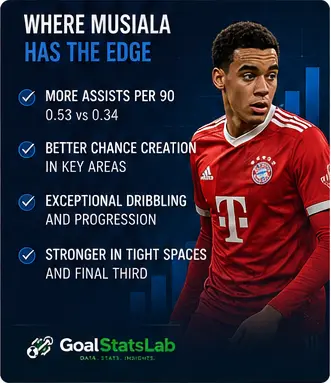
When fully fit, Musiala remains one of Bayern’s most important ball carriers and creators. His 0.53 assists per 90 in the selected data is evidence of his ability to produce chances even during a disrupted campaign.
In this structure:
Saibari would not be a traditional reserve. He would be the first alternative across several positions.
Kompany could also use both players in the same midfield.
Musiala could remain the most advanced creator while Saibari starts slightly deeper, making forward runs from an advanced number-eight position.
This arrangement would provide:
The primary concern would be balance.
Against strong opponents, Bayern might still require a more defensively disciplined midfielder alongside their main holding player.
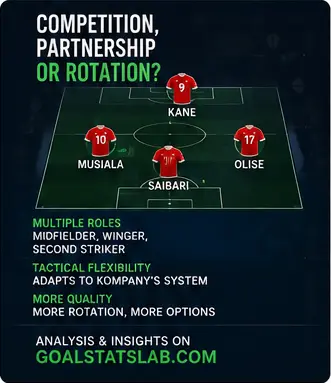
The most aggressive option would place Musiala, Saibari and Olise behind Kane.
Rather than keeping fixed positions, the three attacking midfielders could rotate:
This could become Bayern’s most unpredictable attacking configuration.
It could also leave the team vulnerable if the rotations are not supported by strong rest defence and coordinated pressing.
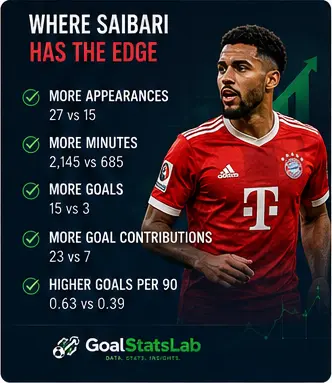
Based on the GoalStatsLab comparison, Saibari’s strongest advantages are:
He played 2,145 minutes compared with Musiala’s 685.
That is highly relevant for a Bayern side competing in the Bundesliga, DFB-Pokal and Champions League.
Saibari produced:
His record suggests he can provide goals from positions behind or around the striker.
Saibari is more inclined to attack depth and arrive inside the area without the ball.
That offers Bayern a different profile from Musiala’s dribbling and close-control creativity.
Musiala recorded 0.53 assists per 90, clearly ahead of Saibari’s 0.34.
Musiala’s ability to receive under pressure, evade opponents and carry the ball through central areas remains difficult to replace.
He already understands Kompany’s structure, his teammates’ movements and the demands of the Bundesliga.
Saibari must still adapt to a new country, team and tactical environment.
The most realistic answer is a combination of all three.
There will be direct competition when Bayern use a single central attacking midfielder. Saibari’s scoring numbers and availability make him more than a depth signing.
There will also be opportunities for partnership because their profiles are complementary.
Musiala is the more natural central creator. Saibari offers greater verticality, physicality and movement into scoring positions.
Most importantly, Bayern now have the depth to rotate without losing an elite attacking profile.
That is particularly valuable after Musiala’s injury-disrupted campaign.
Saibari’s arrival should not be interpreted as the end of Musiala’s status as Bayern’s number 10.
The available evidence instead points towards a broader attacking plan.
Musiala remains the more established creator and is likely to retain a central role when fully fit. Saibari arrives with superior 2025/26 totals, a stronger scoring rate and the versatility to operate in several positions.
The likely hierarchy at the beginning of the season is:
Bayern have not simply signed an alternative to Musiala.
They have signed a player capable of competing with him, complementing him and reducing the club’s dependence on any single attacking midfielder.
That could be the real value of the deal.
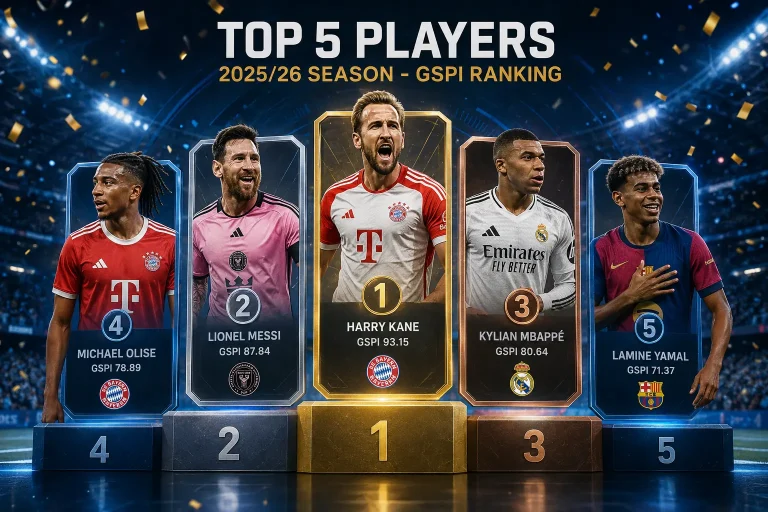
The 2025/26 season produced outstanding individual performances across Europe and North America. Some players dominated through goals, others through creativity, […]

Premier League shots on target data gives us a clearer view of which players are not only shooting often, but […]

Premier League most shots data for the 2025/26 season gives us a clear view of which players are carrying the […]