World Cup 2026 Atlanta: Games, Stadium, Schedule and Tickets
The World Cup 2026 Atlanta is one of the most interesting city-specific stories of the tournament. Atlanta is one of the strongest […]


We are in the middle of it. Right now. The biggest World Cup in the history of football is happening across the United States, Canada, and Mexico —...
By GoalStatsLab
•
Jun 25, 2026
•
11 min read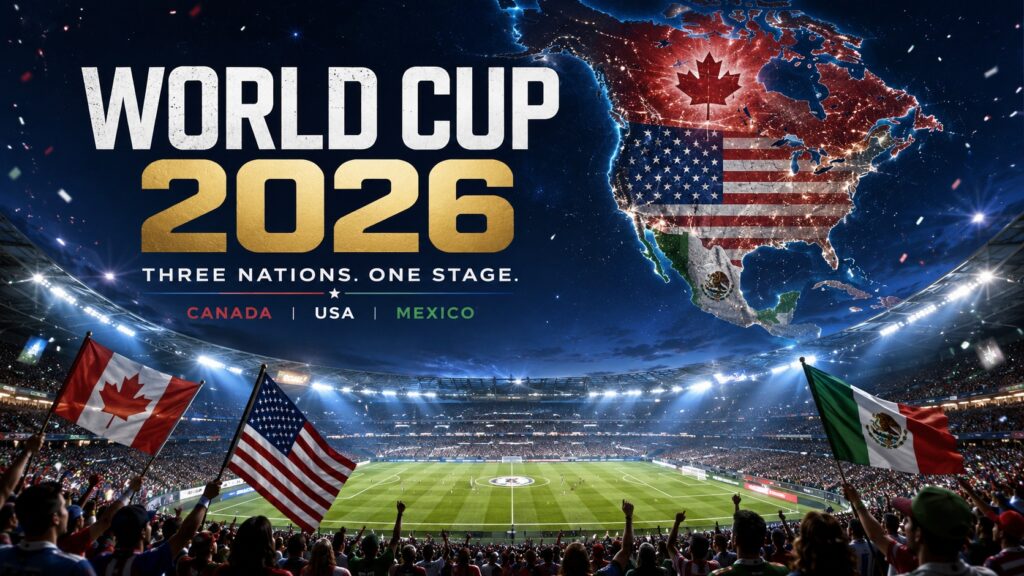
We are in the middle of it. Right now. The biggest World Cup in the history of football is happening across the United States, Canada, and Mexico — and it’s already delivered records, upsets, drama, and moments that people will be talking about for decades.
If you’ve just tuned in and want to catch up fast, or if you’ve been watching every game and just need everything in one place, this is your complete guide to the 2026 FIFA World Cup — the schedule, the groups, the teams, the stadiums, and the stats that tell the story so far.
Let’s start here, because this isn’t just another World Cup. The 2026 edition is genuinely historic in ways that go beyond the usual hype.
48 teams are competing for the first time — up from 32. That means 16 nations who would never have qualified before are here. Curaçao, Haiti, Cabo Verde — teams that fans had never watched in a World Cup are now on the grandest stage football has to offer. And several of them have already made their mark.
104 matches are scheduled in total, compared to 64 at Qatar 2022. More football. More drama. More goals.
Three host nations — the United States, Canada, and Mexico — are sharing hosting duties for the first time in World Cup history. It’s a tournament that genuinely spans a continent, with games stretching from Vancouver, Canada in the northwest to Miami, Florida in the southeast, and all the way south to Guadalajara, Mexico.
The format has also changed. Instead of the old Round of 16 straight from the group stage, the 2026 World Cup introduces a Round of 32, which means 32 teams advance from the groups rather than 16.
The draw took place on December 5, 2025, at Washington D.C.’s Kennedy Center, and the world has been buzzing ever since.
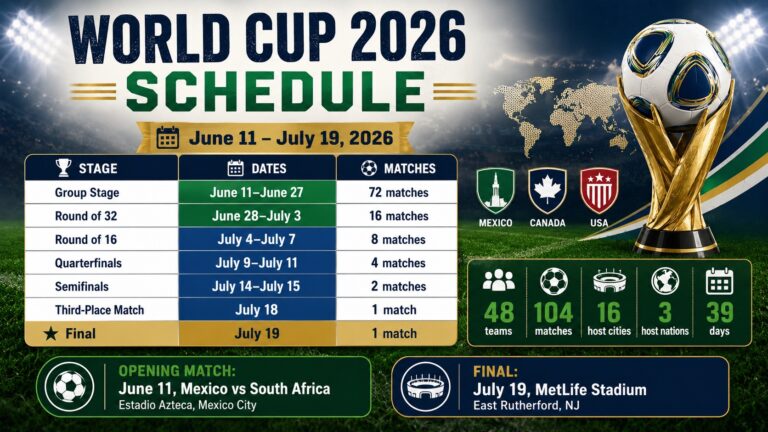
The 2026 FIFA World Cup runs from June 11 to July 19, 2026 — a total of 39 days, the longest World Cup ever played.
| Phase | Dates |
|---|---|
| Group Stage | June 11 – June 28 |
| Round of 32 | June 29 – July 4 |
| Round of 16 | July 5 – July 8 |
| Quarterfinals | July 10 – July 11 |
| Semifinals | July 14 – July 15 |
| Third Place | July 18 |
| Final | July 19, MetLife Stadium, New Jersey |
The opening match took place on June 11 at the Estadio Azteca in Mexico City, where co-host Mexico beat South Africa 2–0 in front of a packed, deafening crowd. The final will be played at MetLife Stadium in East Rutherford, New Jersey — just across the river from New York City — on July 19.
As of today, June 25, the group stage is in its final stretch. Groups D, E, and F are wrapping up their third matchdays today, with Groups G through L to follow over the coming days. The Round of 32 begins June 29.
The 48 teams were drawn into 12 groups of four. Here’s the complete overview:
| Group | Teams |
|---|---|
| A | Mexico, South Africa, South Korea, Czech Republic |
| B | Canada, Bosnia & Herzegovina, Qatar, Switzerland |
| C | Brazil, Morocco, Scotland, Haiti |
| D | USA, Paraguay, Australia, Türkiye |
| E | Germany, Ivory Coast, Ecuador, Curaçao |
| F | Netherlands, Japan, Sweden, Tunisia |
| G | Belgium, Egypt, Iran, New Zealand |
| H | Spain, Uruguay, Saudi Arabia, Cabo Verde |
| I | France, Norway, Senegal, Iraq |
| J | Argentina, Austria, Algeria, Jordan |
| K | Portugal, Colombia, DR Congo, Uzbekistan |
| L | England, Croatia, Ghana, Panama |
The three host nations — Mexico, Canada, and the USA — were pre-assigned to Groups A, B, and D respectively.
This is the most diverse World Cup field ever assembled. Here’s how the 48 spots broke down by confederation:
Defending champions Argentina are in Group J. Five-time winners Brazil are in Group C. European powerhouses Spain, France, England, and Portugal are all in the tournament and considered the main contenders alongside Argentina and Brazil.
Notable first-timers at this World Cup: Curaçao, Haiti (returning after a long absence), and several others. The expanded format opened the door — and many of these nations have not wasted the opportunity.
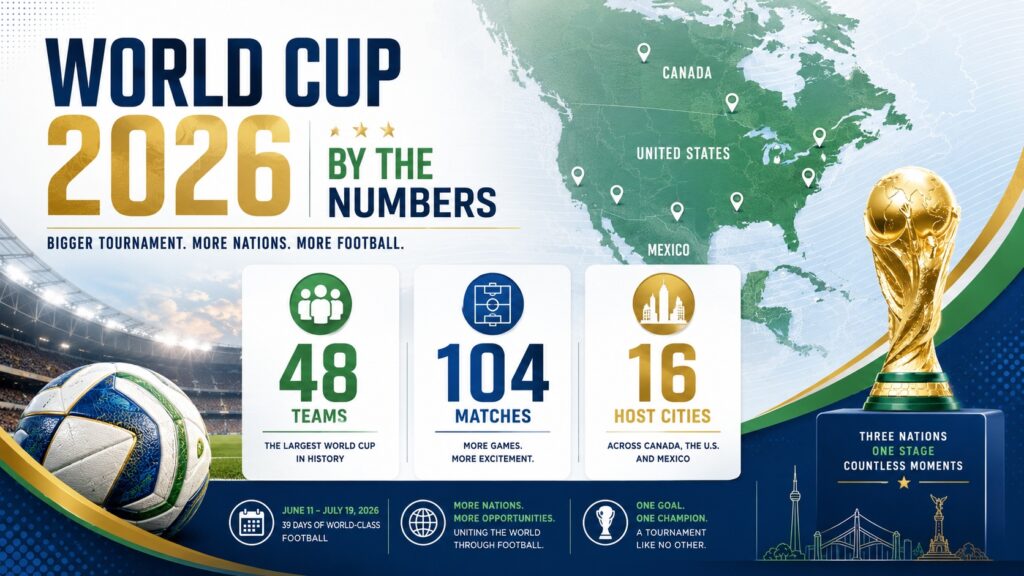
The 2026 FIFA World Cup is being played across 16 stadiums in 16 host cities. It is the first time three countries have ever jointly hosted a World Cup, and the sheer geographic scale is staggering — venues span more than 3,000 miles from coast to coast.
The USA hosts the bulk of the tournament, including all matches from the quarterfinals onward.
| Stadium | City | Capacity | Notable Matches |
|---|---|---|---|
| MetLife Stadium | East Rutherford, NJ | 82,500 | FINAL (July 19) |
| AT&T Stadium | Arlington, TX | 80,000 | Semifinals, QF |
| Mercedes-Benz Stadium | Atlanta, GA | 71,000 | Semifinals, QF |
| SoFi Stadium | Los Angeles, CA | 70,240 | QF, Round of 32 |
| Hard Rock Stadium | Miami, FL | 65,326 | Round of 16, R32 |
| NRG Stadium | Houston, TX | 72,220 | Round of 16, R32 |
| Levi’s Stadium | Santa Clara, CA | 68,500 | R32 |
| Lumen Field | Seattle, WA | 69,000 | R32 |
| Arrowhead Stadium | Kansas City, MO | 76,416 | R32 |
| Lincoln Financial Field | Philadelphia, PA | 69,176 | R32 |
| Gillette Stadium | Boston, MA | 65,878 | R32 |
MetLife Stadium is the crown jewel. Situated just 12 miles from Manhattan, it will host the World Cup Final on July 19. It seats 82,500 and is the largest stadium in the tournament.
AT&T Stadium in Dallas — famously known as “Jerry’s World” — hosted Argentina vs. Austria on June 22, and the crowd of 70,649 was overwhelmingly Argentine. Messi scored twice there, breaking Miroslav Klose’s all-time scoring record in front of a stadium that will not forget that night for a very long time.
Four American venues (AT&T Dallas, NRG Houston, Mercedes-Benz Atlanta, and Lumen Seattle) have retractable roofs with climate control — a major comfort factor in the brutal summer heat of the American South and Southwest.
| Stadium | City | Capacity | Notable Match |
|---|---|---|---|
| Estadio Azteca | Mexico City | 72,766 | Opening match (June 11) |
| Estadio BBVA | Monterrey | 50,113 | Group stage |
| Estadio Akron | Guadalajara | 44,330 | Group stage |
The Estadio Azteca is one of football’s most sacred grounds. It’s the only stadium in history to have hosted three World Cup tournaments (1970, 1986, and now 2026), and the only one to have hosted two finals. Sitting 2,240 meters above sea level, the altitude alone is a challenge for visiting teams. It held the honor of hosting the opening match of this tournament, where Mexico opened with a 2–0 win over South Africa.
| Stadium | City | Capacity | Notes |
|---|---|---|---|
| BMO Field | Toronto | 45,500 | Expanded for 2026 |
| BC Place | Vancouver | 48,821 | Retractable roof |
Canada is hosting a men’s World Cup for the very first time, and both venues have embraced the moment. BMO Field in Toronto was expanded from 30,000 to 45,500 seats specifically for this tournament, while BC Place in Vancouver uses its retractable roof to protect fans from the Pacific Northwest rain.
The 2026 World Cup has already produced more drama in the group stage than most tournaments deliver across their entire run. Here are the biggest stories.
Lionel Messi has been the defining figure of the tournament so far. In Argentina’s opening game against Algeria on June 16 in Kansas City, Messi scored a hat-trick — the first of his World Cup career. That made him the oldest hat-trick scorer in World Cup history at 38 years and 357 days. Then, against Austria on June 22 in Dallas, he scored twice more, taking his career World Cup total to 18 goals and officially becoming the all-time leading scorer in World Cup history, surpassing Miroslav Klose’s record of 16. Messi now holds 5 goals at this tournament alone across just two games.
Cristiano Ronaldo, meanwhile, made history of his own. Playing for Portugal in Group K, Ronaldo scored in the match against Uzbekistan to become the first man ever to score in six different World Cup tournaments. His rivalry with Messi, improbably, still burns on the grandest stage.
France’s Kylian Mbappé has also been electric. He scored a brace against Senegal in France’s opener, breaking the French record for international goals. France have been imperious in Group I, winning both their first two games with a combined 6–1 scoreline.
Germany announced themselves with a historic opening day: a 7–1 demolition of Curaçao in Group E — the latest in a series of massive scorelines that have made this World Cup one of the highest-scoring in memory.
The 100th goal of the 2026 World Cup was scored by Cody Gakpo of the Netherlands against Sweden on June 20. The Netherlands reached three figures faster than any World Cup in history.
Cabo Verde held Spain to a 0–0 draw in their opening game — reportedly the biggest single-game upset by odds in 2026 World Cup history so far. Spain, who had been installed as one of the pre-tournament favorites, were stunned by Vozinha’s goalkeeping heroics. Spain have since responded well, but the moment felt like a reminder that this expanded format gives every nation a genuine chance.
South Africa beat South Korea in the final game of Group A, going through to the Round of 32. For a nation that had never won a knockout round in World Cup history, the scenes were extraordinary.
Norway have been the breakout team of the group stage. Erling Haaland scored twice on his World Cup debut as Norway beat Iraq 4–1, then followed it up with a 3–2 comeback win over Senegal. They sit level on 6 points with France in Group I heading into a final matchday showdown that could define the group.
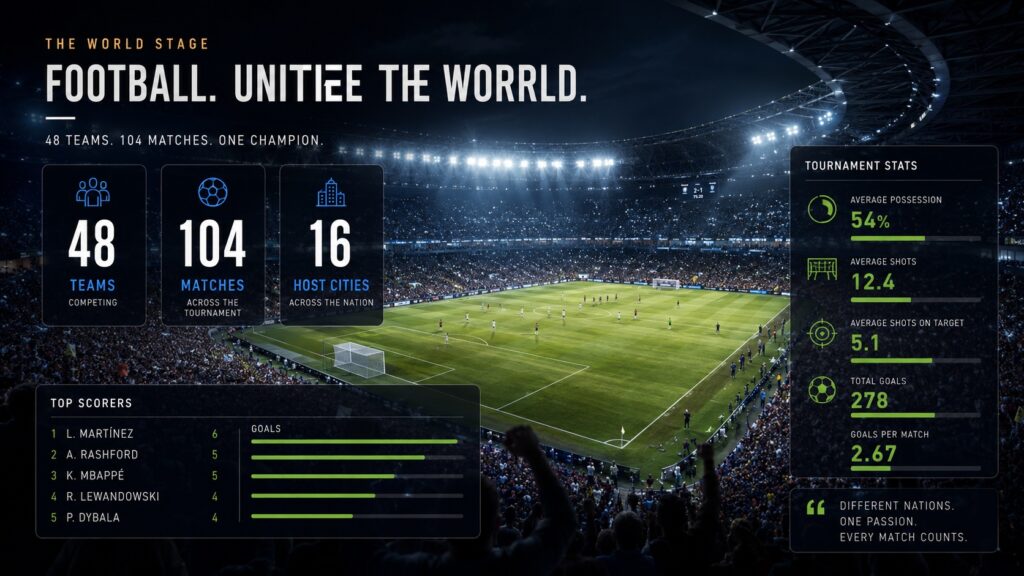
Here’s a snapshot of the key statistics from the 2026 FIFA World Cup so far:
| Stat | Figure |
|---|---|
| Total teams competing | 48 |
| Total matches scheduled | 104 |
| Group stage matches | 72 |
| Knockout stage matches | 32 |
| Host cities | 16 |
| Host nations | 3 (USA, Mexico, Canada) |
| Tournament duration | 39 days |
| Goals in first 40 games | 100+ |
| Top scorer so far | Messi (5 goals) |
| All-time WC goals record | Messi (18 career goals) |
| Youngest player in tournament | Gilberto Mora (Mexico, born Oct. 14, 2008) |
| Opening match result | Mexico 2–0 South Africa (June 11) |
| Final date & venue | July 19, MetLife Stadium, New Jersey |
One stat that stands out above all: the goals-per-game ratio at this World Cup is tracking significantly higher than recent tournaments. The expanded format, with more mismatches in group play, has generated more attacking football — and fans have loved every minute of it.
With the group stage nearing its end and the Round of 32 just days away, here’s how the contenders shape up.
Argentina are the defending champions and playing like it. With Messi in this form at age 38, you simply cannot rule them out. They’re through, they’re confident, and Messi looks like he wants one more moment of glory before the curtain falls.
France have been the most controlled and clinical side in the tournament so far. Mbappé is at the peak of his powers. They look dangerous in a way that only the 2018 French side has matched in recent memory.
Spain have the best squad depth in the tournament and Lamine Yamal — the generational teenage talent — has been getting better with every game. After the shock draw with Cabo Verde, they bounced back sharply.
Germany were ruthless in their opener and have looked organized and dangerous. Denis Undav has been a revelation. They arrive at knockout football with momentum.
Norway are the tournament’s wildcard. Haaland hasn’t even hit top gear yet, and they have a full-team system built around making him devastating. Don’t sleep on them.
Brazil have Vinícius Júnior and the firepower to go all the way — but questions about their consistency remain, even under Carlo Ancelotti.
England have flattered to deceive slightly, with a 0–0 draw against Ghana raising eyebrows after their impressive opening against Croatia. But the squad is deep, and the knockout rounds suit them.
In the United States, matches are broadcast on FOX and FS1 in English, and on Telemundo and Universo in Spanish. Streaming is available via FOX One, Peacock, and the Telemundo app.
In the UK, the BBC and ITV are sharing broadcasting rights.
For fans following via scores and updates, platforms like FIFA+, ESPN, CBS Sports, and BBC Sport offer live updates, highlights, and in-depth coverage.
When is the 2026 World Cup?
The 2026 FIFA World Cup runs from June 11 to July 19, 2026.
Where is the 2026 World Cup?
It is co-hosted by the United States, Canada, and Mexico across 16 cities and stadiums.
How many teams are in the 2026 World Cup?
48 teams — the largest field in World Cup history.
Where is the 2026 World Cup Final?
The final will be played at MetLife Stadium in East Rutherford, New Jersey, on July 19, 2026.
Who is the top scorer at the 2026 World Cup?
As of June 25, Lionel Messi leads with 5 goals. He also holds the record for most career World Cup goals of all time with 18.
How many matches are at the 2026 World Cup?
104 matches in total — 72 in the group stage and 32 in the knockout rounds.
Who are the favorites to win the 2026 World Cup?
Argentina (defending champions), France, Spain, and Germany are considered the leading contenders, with Norway, Brazil, and England also in the mix.
What is the new format for the 2026 World Cup?
48 teams play in 12 groups of four. The top two from each group, plus the eight best third-place teams, advance to a brand-new Round of 32 — giving 32 teams a chance in the knockout stage.
Who opened the 2026 World Cup?
Mexico played the opening match against South Africa at the Estadio Azteca in Mexico City on June 11, 2026, winning 2–0.
Last updated: June 25, 2026. This article will be updated as the tournament progresses through the knockout rounds.
Continue readingWorld Cup 2026 World Cup 2026Is Messi Playing in 2026?
The World Cup 2026 Atlanta is one of the most interesting city-specific stories of the tournament. Atlanta is one of the strongest […]
There are 104 matches in the 2026 FIFA World Cup. One hundred and four. Even saying it out loud still […]
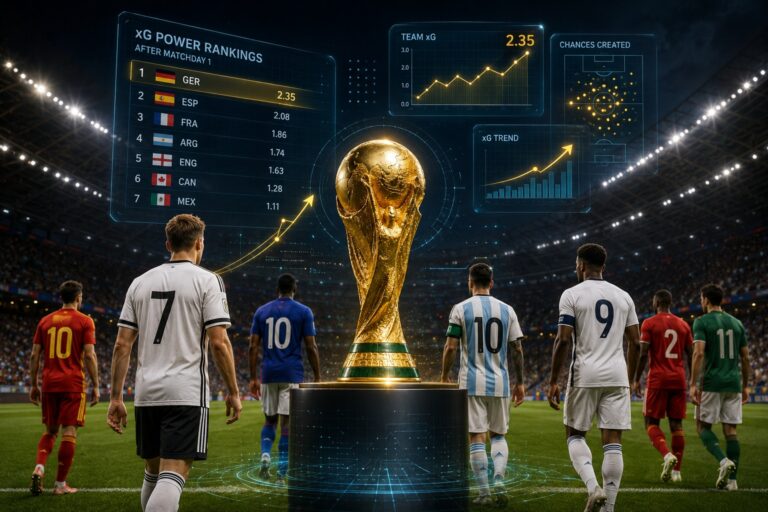
Updated July 5, 2026 — this article originally covered Matchday 1 xG signals. It has now been updated to show […]