World Cup 2026: Schedule, Groups, Teams, Stadiums and Stats
We are in the middle of it. Right now. The biggest World Cup in the history of football is happening […]


How many games are in a Premier League season? A Premier League season contains 380 matches. Each of the 20 teams plays 38 games: 19 at home and...
By GoalStatsLab
•
Jul 14, 2026
•
5 min read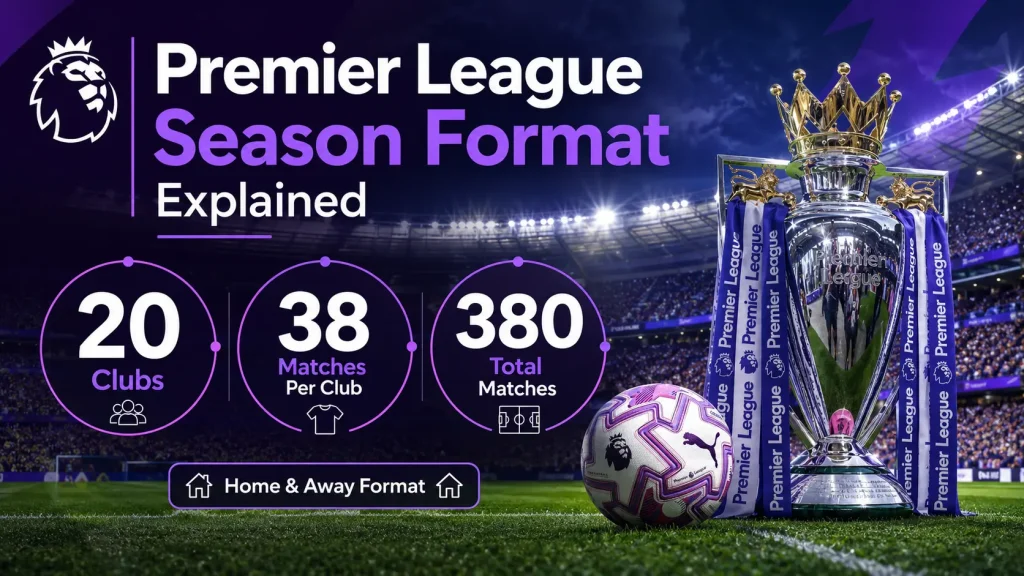
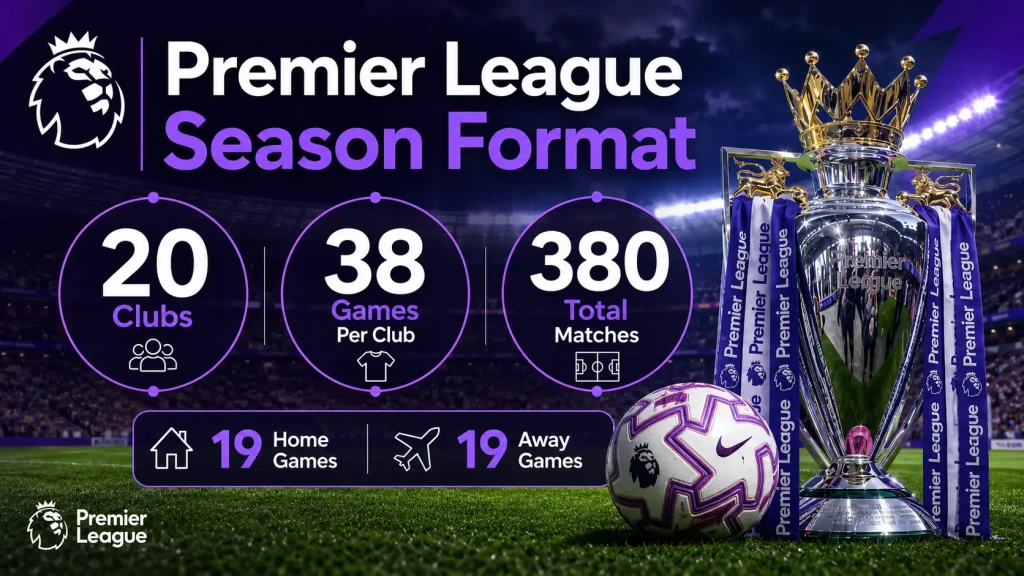
A Premier League season contains 380 matches. Each of the 20 teams plays 38 games: 19 at home and 19 away.
The Premier League is built on a simple round-robin format — every club faces every other club twice, once at home and once away. With 20 clubs in the division, that structure produces exactly 380 fixtures each season, from the opening weekend in August through to the final day in May.
Every club in the Premier League plays 38 matches per season:
This is the same for every team regardless of where they finish in the table — the fixture list doesn’t shrink for smaller clubs or grow for the eventual champions. All 20 sides play the identical number of matches, which is what makes the final table directly comparable from top to bottom.
The maths behind the schedule is straightforward once you break it down:
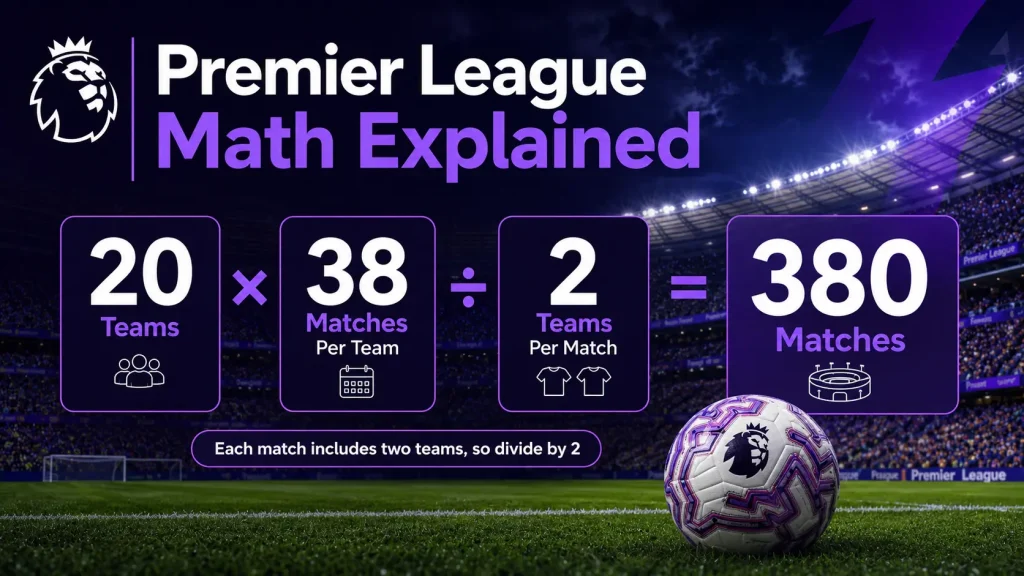
20 teams × 38 matches ÷ 2 = 380 matches
Here’s why the division by two matters: if you just multiplied 20 teams by 38 games, you’d get 760 — but that counts every match twice, once for each team involved (for example, Arsenal vs Chelsea would be counted once in Arsenal’s 38 and once in Chelsea’s 38). Dividing by two removes that double-count and leaves the true number of individual fixtures played across the season: 380.
A full season is spread across 38 matchweeks (sometimes called “gameweeks”), one for each round of fixtures. In a typical matchweek, all 20 clubs play once, meaning 10 matches take place.
In practice, matchweeks are rarely played in a single neat block. Fixtures are usually spread across a Friday-to-Monday window, and some rounds are split further to accommodate:
So while there are 38 matchweeks on paper, several of them are played out over multiple days rather than all on one Saturday. A handful of rounds each season — usually around the festive period and over the Easter weekend — are also played in midweek to fit extra fixtures into a congested calendar, on top of the usual weekend schedule.
The season also includes one fixture round that’s slightly different from the rest: the final matchweek. Every club kicks off at exactly the same time on the last day of the season, rather than being spread across a weekend, so no team has an advantage of knowing another result before their own match finishes.
A standard Premier League season runs from August through to May, typically lasting around nine to ten months.
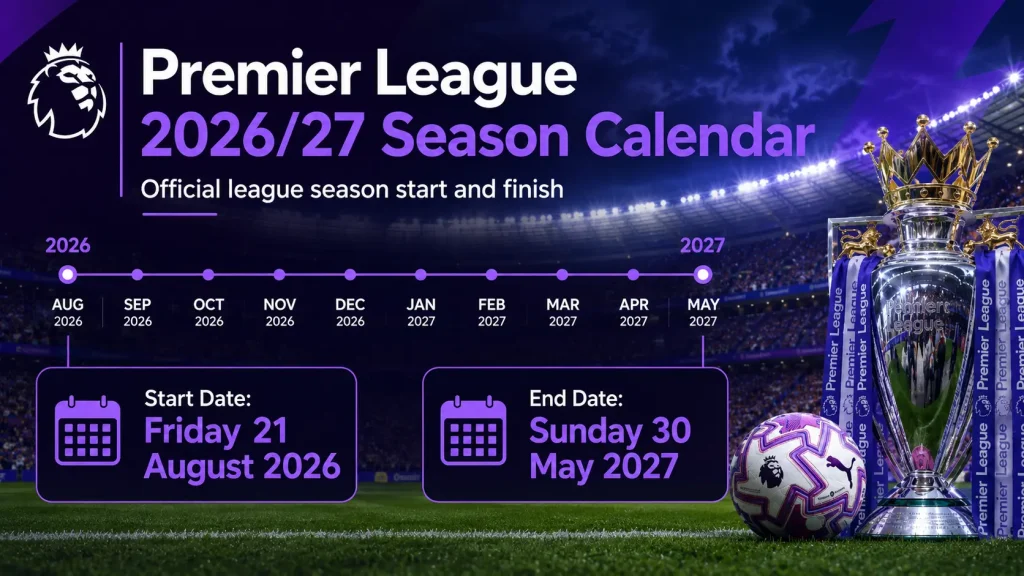
For the 2026/27 season, the campaign is set to begin on Friday, 21 August 2026 and conclude on Sunday, 30 May 2027, when every team plays its final match at the same kick-off time on the last day of the season — a tradition designed to keep the title race and relegation battle fair right to the final whistle.
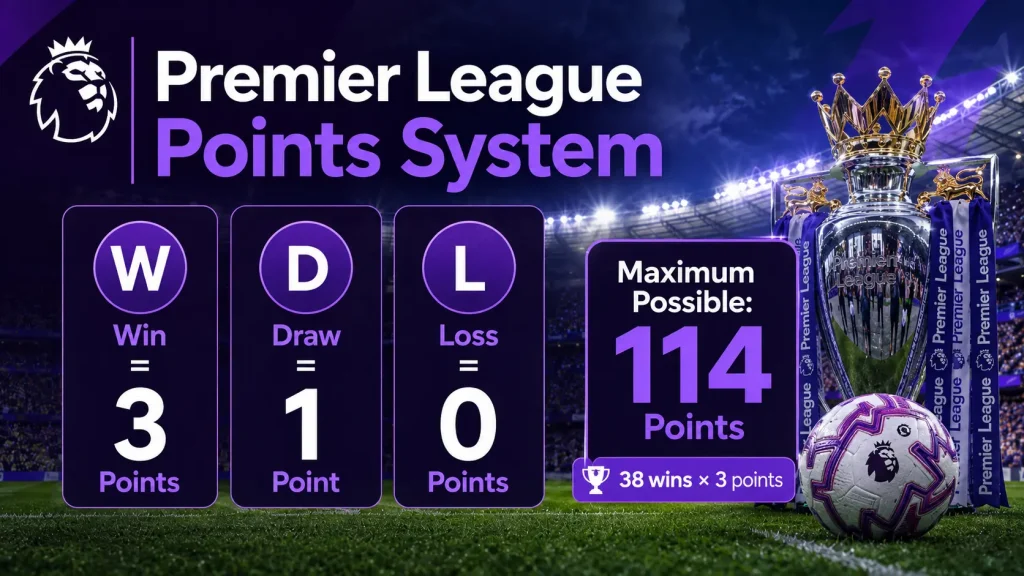
Points are awarded under the standard football system:
Since each team plays 38 matches, the theoretical maximum is:
38 wins × 3 points = 114 points
No club has ever won all 38 of its matches in a season, so 114 remains a purely theoretical ceiling. The actual record for most points in a single Premier League season is 100 points, set by Manchester City in 2017/18 — the only time a team has reached or passed the 100-point mark. That title-winning campaign saw City win 32 matches, draw four and lose just two, finishing 19 points clear of the runner-up.
In an average season, the champions tend to finish somewhere in the high-80s to mid-90s in points, while three points typically separate mid-table survival from a relegation battle in the final weeks.
No — the 380-match total refers strictly to league fixtures. Domestic cups and European competitions run alongside the league season but are entirely separate competitions with their own fixture lists, and none of those matches affect a club’s Premier League record. The main competitions to distinguish are:
A club competing in all of these could realistically play 50–60+ matches across a single season once cup runs and European group stages are included — but only the 38 league fixtures count toward Premier League points and the final table.
| Metric | Number |
|---|---|
| Clubs in the division | 20 |
| Games per club | 38 |
| Total games in the season | 380 |
| Home games per club | 19 |
| Away games per club | 19 |
| Matchweeks per season | 38 |
| Points for a win | 3 |
| Maximum possible points | 114 |
| Clubs relegated each season | 3 |
How many home games does each Premier League team play? Each club plays 19 home games per season — one against every other team in the division.
How many away games does each team play? Each club also plays 19 away games per season, mirroring their home fixtures against the same 19 opponents.
Why are there 380 Premier League matches? Because 20 clubs each play 38 games (home and away against every other club), and dividing the total team-games (20 × 38 = 760) by two — since each match involves two teams — gives 380 individual fixtures.
Does every team play each other twice? Yes. Every club faces each of the other 19 clubs twice: once at home and once away.
How many games are needed to win the Premier League? There’s no fixed number of wins required — the title goes to whichever club finishes with the most points after all 38 matches. In practice, champions have historically needed somewhere between the low-80s and 100 points to win the league, depending on how competitive that particular season is.
How many matches can an English club play in one season? Beyond their 38 league games, a club can add FA Cup, EFL Cup and, if they qualify, Champions League, Europa League or Conference League fixtures. Clubs that go deep in multiple competitions can end up playing 55–60+ matches across a full season.

We are in the middle of it. Right now. The biggest World Cup in the history of football is happening […]

Bundesliga Corners rankings for 2025: Bayern München lead with 6.35 using GoalStatsLab data.